The Woodland Kingfisher: an ecological portrait of Africa’s blue flash
Bright, vocal and unmistakable against the green of summer woodlands, the Woodland Kingfisher (Halcyon senegalensis) is one of sub-Saharan Africa’s most charismatic small birds. Often heard before it is seen, this electric-blue-backed kingfisher is a familiar herald of seasonal change across many parts of the continent. In this piece, I’ll take you through its identity, habitat, diet and foraging style, breeding system and territorial behaviour, migration patterns, interactions with other species, and conservation outlook — all from the perspective of ecological function and the role this species plays in African woodlands and savannas.
A quick ID and range snapshot
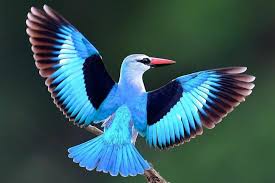
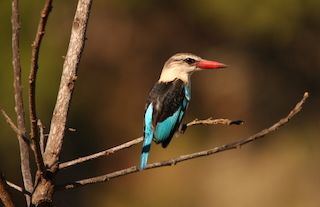
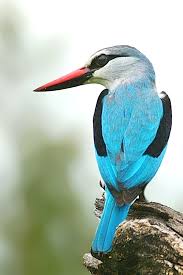
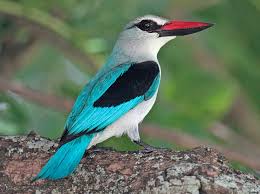
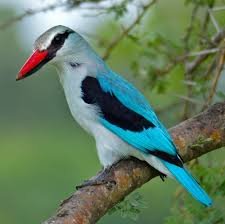
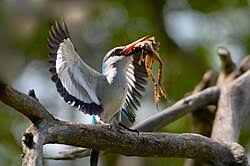
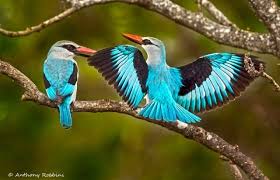
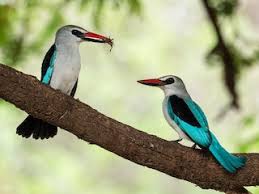
The Woodland Kingfisher is a medium-sized tree kingfisher with a brilliant blue back, white underparts and a large, two-coloured bill (upper mandible red, lower mandible black). In flight, you’ll notice strong, direct wingbeats and a flash of white lining on the underwing. Juveniles are duller and may show a brown bill, but adults are unmistakable at close range. Three subspecies are widely recognised across their range. The species occurs broadly across tropical Africa south of the Sahara and is common in many suitable wooded habitats.
Habitat — a kingfisher that prefers trees over rivers
Unlike the stereotypical image of a kingfisher fishing along a riverbank, the Woodland Kingfisher is primarily a tree and savanna species. It favours woodlands, open savanna with scattered trees (often Acacias), riverine edges, and even well-treed suburban areas. Crucially, its presence depends on the availability of perching sites and tree cavities for nesting rather than close proximity to water. Where suitable trees remain, Woodland Kingfishers adapt well to human-modified landscapes and can nest in tree holes, disused woodpecker or barbet cavities, nest boxes, and sometimes even under eaves or in artificial cavities.
Diet and foraging — opportunistic predator of the canopy and understorey
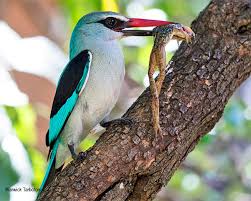
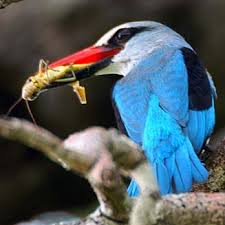
Ecologically, the Woodland Kingfisher is an opportunistic predator of terrestrial and arboreal prey rather than a specialist fish-catcher. Its diet is dominated by insects (large beetles, grasshoppers, caterpillars and other arthropods), but it will also take spiders, scorpions, small amphibians, lizards, small snakes and occasionally small birds and nestlings. Foraging is typically done from an exposed perch: the kingfisher sits motionless, watches, then sallies to the ground or into foliage to seize prey before returning to its perch to consume it. This “sit-and-pounce” strategy positions the species as an important insect and small-vertebrate predator in woodland food webs.
Territory, behaviour and social life
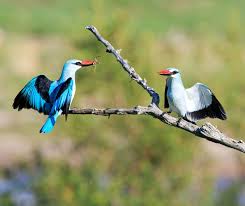
On the breeding grounds, Woodland Kingfishers are territorial and commonly occur in pairs holding discrete territories. They can be aggressive in defending their area — driving off intruders, even larger birds or humans who come too close to the nest. Display behaviour includes wing-spreading to show the white linings and frequent calling. Outside the breeding season, individuals may be more tolerant of others and can be seen in small groups, but pair bonds and territorial defence during nesting are strong. Both parents participate in nest defence and chick provisioning.
Breeding ecology — nest cavities and clutch dynamics
Reproduction hinges on access to suitable nest cavities. Woodland Kingfishers usually nest in tree holes created by woodpeckers or barbets, but they readily occupy natural cavities and artificial boxes. Clutches commonly contain 2–4 white eggs, and both adults incubate and feed the young. Egg incubation and chick-rearing periods are relatively short compared with larger birds; nestlings fledge after a couple of weeks but continue to depend on parental provisioning for some time after leaving the nest. In many parts of southern Africa, the breeding season is strongly seasonal and closely tied to the summer rains — pairs arrive, pair off, and breed quickly after returning.
Migration and seasonal movements — following the rains
One of the most interesting ecological features of the Woodland Kingfisher is its intra-African migratory behaviour. While equatorial populations tend to be resident, northern and southern populations undertake seasonal movements tied to rainfall patterns. Birds that breed in southern Africa typically migrate northwards to the equatorial zone in the austral winter, while northern breeders may move southward into more favourable woodland habitats during their local wet seasons. Citizen science and ringing studies show fairly predictable arrival and departure windows in some regions (for example, many nests in parts of southern Africa coincide with the November–March rainy season), meaning the woodland kingfisher is often a reliable seasonal indicator.
Role in the ecosystem — more than a pretty bird
Though not a keystone species, Woodland Kingfishers perform several useful ecological functions:
- Predation on insect outbreaks: By feeding on large insects and some crop pest species, they help regulate local invertebrate populations.
- Seed dispersal and nutrient movement (indirect): Through their feeding and perching behaviour — and by attracting predators and scavengers to their feeding sites — they participate in nutrient redistribution within woodlands.
- Cavity-dependent interactions: Their reliance on tree cavities links them to the guild of cavity-nesters (woodpeckers, barbets, some owls). The presence of healthy large trees therefore benefits multiple species; conversely, the loss of mature trees reduces available nest sites and affects community composition.
Because these birds are conspicuous, vocal and fairly tolerant of modified landscapes, they also serve as useful sentinel species for monitoring woodland health and seasonal changes.
Predators, parasites and mortality
Like other small birds, Woodland Kingfishers face predation risks from snakes, raptors and arboreal mammals that can access nest cavities or ambush perched adults. Nest predation can be a key source of reproductive loss. They are also subject to brood parasites in some regions, and ectoparasites (mites, lice) can affect nestling condition. Human-related threats such as the removal of large trees, illegal collection of nestlings, and collisions with man-made structures contribute locally to mortality. However, compared with many habitat specialists, the Woodland Kingfisher’s flexibility in nesting (use of artificial cavities and human structures) gives it resilience in landscapes where trees remain.
Conservation status and management implications
Globally, the Woodland Kingfisher is assessed as Least Concern on the IUCN Red List — its range is enormou,s and populations are stable enough not to trigger higher threat categories. That said, local declines can occur where woodland is cleared or large trees are removed. Conservation measures that benefit the species are straightforward and also benefit broader woodland biodiversity: protect mature and dead standing trees (important for cavities), install and monitor nest boxes where appropriate, maintain connectivity of wooded patches, and reduce indiscriminate removal of nesting cavities. Citizen science (bird atlases, ringing and local monitoring) has been particularly useful in tracking arrival times, breeding success and range shifts that might accompany changing climate patterns.
Responses to environmental change — plasticity and limits
The Woodland Kingfisher shows important signs of ecological plasticity. It adapts to a range of wooded habitats, accepts artificial nest sites, and times reproduction to follow favourable rainy seasons. These traits buffer it against some of the changes in human-dominated landscapes. However, there are limits: wholesale conversion of woodlands to intensive agriculture, removal of mature trees, and climate-driven alterations to rainfall timing and intensity may disrupt the tightly coupled phenology between insect prey availability and breeding. Long-term monitoring is needed to detect subtle shifts in migration timing or breeding success that could indicate larger ecosystem changes.
Research gaps and priorities
For ecologists and conservationists interested in the species, several questions remain valuable to pursue:
- Fine-scale migration routes and stopover ecology: While broad patterns are known, tracking studies (lightweight GPS or geolocators) could reveal routes, timing and critical stopover sites.
- Climate change impacts on breeding phenology: Monitoring the match/mismatch between peak prey abundance and nestling demand should be a priority.
- Population genetics and subspecies structure: Recent genomic work suggests interesting intraspecific variation — understanding how subspecies are structured will help in regional conservation planning.
A final note — living with the kingfisher
For bird lovers and land managers, welcoming Woodland Kingfishers is often as simple as maintaining large trees, providing nest boxes where cavities are scarce, and preserving a mosaic of trees and open areas. Their bright colours, explosive calls and seasonal comings and goings enrich the soundscape and signal that the cycle of the rains — and the pulse of insect life — is underway. As adaptable yet cavity-dependent woodland birds, Woodland Kingfishers remind us that conserving trees and the small-scale structural diversity of landscapes is one of the easiest and most effective acts of conservation we can do.